
What Every Brand Can Learn From FIFA’s CRM Strategy
The FIFA World Cup 2026 has just delivered one of the most watched sporting events in history – and behind the spectacle, there was a CRM strategy running at a scale most brands can barely imagine. Millions of fans. Dozens of languages. Ticketing, merchandise, broadcast rights, sponsor activations, and loyalty programmes all operating simultaneously.
If you’ve ever wondered how a CRM strategy holds all of that together, you’re in the right place. FIFA named Salesforce (one of our own technology partners) as Official Tournament Supporter of both the FIFA World Cup 2026 and the FIFA Women’s World Cup 2027, in a single multi-year agreement spanning two of the biggest events in world sport.
We work with Salesforce every day, and what FIFA has built with it is a powerful example of how any brand should approach CRM – no matter the platform.
We recently wrote an article about how brands can turn world cup fan data into customer loyalty. See below for more information.
How Brands Can Turn World Cup Fan Data Into Customer Loyalty
What Does CRM Strategy Mean and Why Does It Matter at World Cup Scale?
CRM at its simplest is the strategy and technology you use to manage interactions with your customers across every touchpoint – from the first time they hear about you, to the moment they become loyal advocates. For FIFA, those “customers” are fans, sponsors, broadcasters, and ticketing partners. For your brand, they’re the people who buy from you, engage with your campaigns, and keep coming back.
The World Cup isn’t just a benchmark because of its size – it’s because of its complexity. FIFA has to manage multiple audience segments, across different channels, in real time, without anything breaking. And that’s exactly the same challenge most mid-to-large consumer brands face.
Whether it’s email, SMS, loyalty, or ecommerce – you’re still trying to coordinate journeys, personalise experiences, and keep everything running smoothly behind the scenes.
Research on digital transformation in the sports industry from Deloitte shows that organisations using CRM and loyalty data to personalise experiences see measurable improvements in engagement.
And that’s not just true for sport. It’s a core CRM principle that applies to retail, ecommerce, and any brand trying to build stronger customer relationships.
What Are the 4 Pillars of CRM?
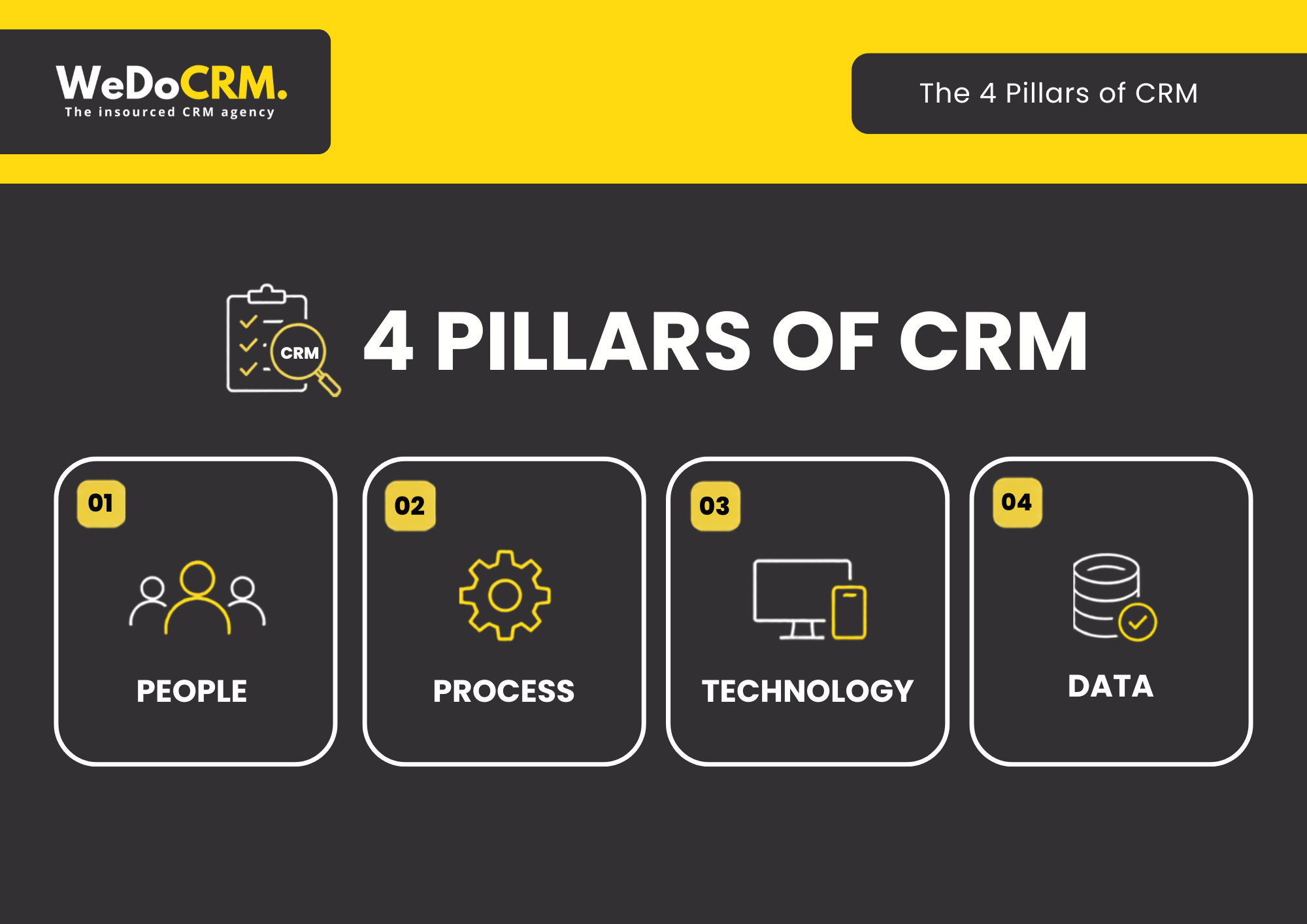
The 4 pillars of CRM are people, process, technology, and data. Together, they determine whether your CRM strategy actually works. FIFA’s approach to the World Cup demonstrates all four in action, and each one has a direct parallel for your brand.
1. People – Breaking Down Silos
One of the biggest CRM failures isn’t tech, it’s silos. Marketing, ecommerce, and CX all working separately, with no shared view of the customer.
FIFA’s operation with Salesforce CRM avoids this by using one unified profile across teams built around unified customer profiles that every relevant team can access. So for example: When a fan buys a ticket, that data informs the merchandise team, the broadcast team, and the loyalty programme. Which equals = no silos, and no missed opportunities!
They also use Slack to coordinate workforce management across all 16 host cities, they give teams one shared system to work from, in real time.
Takeaway for your brand: If your marketing, ecommerce, and CX teams are working from different data sources, you don’t have a CRM strategy – you have three separate ones. Unifying your customer view is step one.
What to do next:
➡ Map where your customer data lives
➡ Pick one journey and spot where it breaks
➡ Use one identifier (like email) to connect data
➡ Start syncing systems (even basic integrations)
➡ Align teams around shared goals (not channel KPIs)
2. Process – Stop Rebuilding from Scratch
FIFA doesn’t start fresh every tournament, it keeps the data from last time – fan profiles carry forward. Behavioural signals compound. Segmentation improves and they build on it.
Too many brands do the opposite though, rebuilding their CRM strategy from scratch every campaign cycle, so everything you have paid to collect is completely wasted!
Takeaway for your brand: Use every campaign as a learning opportunity.
➡ Keep your customer segments updated
➡ Review what worked (and what didn’t)
➡ Feed those insights into your next campaign
➡ Build journeys that improve over time
Because every time you start from scratch, you lose what you’ve already learned.
3. Technology – Platform-Agnostic Thinking
Most brands reading this already have a CRM platform. So the lesson here isn’t “switch CRM platforms” it’s a different question: is your current platform actually being used the way FIFA is using Salesforce, or is it running on default settings?
FIFA isn’t just using Salesforce to send emails. It’s using it to coordinate teams across 16 host cities and manage fan data across multiple countries, in one connected system. Most CRM platforms — Salesforce, HubSpot, Iterable, whatever you’re on – can do far more than the average brand actually uses them for. The tool usually isn’t the limit. How it’s configured and used is.
Takeaway: Before assuming you need a new platform, check whether you’re using the one you have properly. 43% of CRM users use less than half of their system’s features, so for most brands, the gap isn’t the tool it’s how it’s set up and used. A CRM audit is usually the fastest way to find out which one you’re dealing with.
4. Data – Clean, Trusted, Actionable
FIFA manages fan data across multiple countries, languages, and consent frameworks. The data has to be clean, compliant, and trustworthy — because every personalisation decision downstream depends on it.
According to Forrester’s 2024 US Customer Experience Index, customer-obsessed organisations reported 41% faster revenue growth and 51% better customer retention than those that weren’t. That kind of outcome doesn’t happen with dirty data.
Takeaway for your brand: If you can’t trust your data, you can’t trust your reporting — and you certainly can’t personalise effectively. Data quality isn’t a technical nicety. It’s a commercial priority.
If you’re not sure where to start, this guide breaks it down: What is data cleansing and why does it matter? Simple rule: Clear strategy → clean data → better results.
How Real-Time Segmentation Separates Good CRM From Great CRM
One of the most impressive things about FIFA’s fan engagement during the World Cup is how quickly it adapts. A fan who watches the group stage from one country, travels to the knockout rounds, and buys merchandise in a different city – their profile updates in real time. The communications they receive reflect where they are in their journey, not where they were three weeks ago when the segmentation rules were written.
FIFA’s approach shows what “great” looks like: for the Women’s World Cup 2027, Salesforce’s Agentforce 360 is set to reason over live tournament data to personalise fan support in the moment, not against a segment written in advance.
Segmented, behaviour-driven campaigns consistently outperform generic broadcast sends.
Takeaway for your brand: Check how often your segmentation updates.
If it’s weekly or monthly, you’re already behind your customers’ behaviour.
Real-time (or near real-time) should be the goal, and most modern CRMs support it.
If you’re not sure how to get there, this guide breaks down how to segment and target your customers more effectively: How to segment and target your customers through CRM
Your CRM Strategy Checklist – Benchmarked Against the World’s Biggest Event
Here’s a practical checklist you can use to benchmark your own CRM strategy, regardless of which platform you’re on. These are the questions FIFA’s operation answers well – and the ones your brand should be able to answer too.
- Do all customer-facing teams share a single, unified view of the customer?
- Does your segmentation update based on real-time behaviour, or is it set in advance?
- Are your CRM learnings carrying forward between campaigns, or resetting each time?
- Can you trust your data enough to make personalisation decisions confidently?
- Is your CRM platform serving your strategy – or is your strategy constrained by your platform?
- Do you have visibility into the ROI your CRM investment is actually delivering?
- Are your acquisition and retention strategies connected, or running independently?
If you answered “no” or “not sure” to more than two of those, your CRM strategy has gaps worth addressing. None of these require a platform change — they require clearer strategic thinking and better execution. That’s exactly what a good acquisition-to-retention strategy looks like in practice.
What This Means for Your Brand Right Now
If you’re not sure where your CRM strategy stands, a CRM audit is the fastest way to find out. We work across Salesforce, HubSpot, Iterable, Customer.io, and Dotdigital – so whatever platform you’re on, our CRM consultants can give you an honest view of where you are and what to do next.
At WeDoCRM, we understand CRM strategy at the level FIFA and Salesforce operate at – and we translate that thinking for brands of every size. If you’re ready to benchmark your CRM and build something that actually compounds over time talk to our team today!
We look forward to hearing from you!
 Book your discovery call | Explore our CRM services
Frequently Asked Questions – CRM Strategy
What can consumer brands learn from FIFA’s CRM strategy?
The most transferable lessons are structural, not budgetary. Unified customer data, real-time segmentation, and carrying learnings forward between campaigns are all achievable on mid-market CRM platforms. You don’t need FIFA’s infrastructure – you need FIFA’s discipline around data and continuity.
Does this approach work on platforms other than Salesforce?
Absolutely. The strategic principles – unified data, real-time triggers, continuous improvement – apply regardless of whether you’re on HubSpot, Iterable, Customer.io, Dotdigital, or any other platform. The platform should serve the strategy, not define its limits. Our CRM consultants work across all of these and can advise on the right approach for your setup.
How do I know if my CRM strategy needs an audit?
If you can’t confidently answer questions about your data quality, segmentation logic, or campaign ROI – or if your teams are working from different customer data sources – those are strong signals. A CRM audit gives you a clear picture of where the gaps are and what to prioritise, without requiring a full platform migration to fix them.
How important is data quality in CRM?
Critical. If your data is incomplete, outdated, or inconsistent, everything built on top of it suffers – from segmentation to personalisation to reporting. Clean, reliable data is the foundation of any effective CRM strategy.
What does “good” CRM personalisation actually look like?
It goes beyond using a first name. Good personalisation reflects real customer behaviour, what someone has browsed, bought, or engaged with recently. It should feel timely and relevant, not generic or pre-planned weeks in advance.
What’s the difference between campaigns and CRM strategy?
Campaigns are short-term executions. CRM strategy is the long-term system behind them, how you manage data, segment audiences, and build ongoing customer relationships. Strong campaigns come from a strong underlying strategy.