
Salesforce vs Microsoft Dynamics 365: Which Platform Is Best?
The Salesforce vs Microsoft Dynamics debate is one of the most common conversations we have with businesses evaluating their CRM options. Both platforms are genuinely powerful… Both have loyal followings and can cause serious headaches if you choose the wrong one for your situation. The honest answer to which is better? It depends entirely on your business – your team, tech stack, ambitions, and how you actually work day to day.
This CRM platform comparison breaks down the real differences between Salesforce and Dynamics 365, so you can make a decision based on what matters to your business rather than marketing claims from either vendor.
Which Is Better, Salesforce or Microsoft?
Neither platform is objectively better – but one is almost certainly a better fit for your specific situation. Salesforce leads on CRM depth, ecosystem breadth, and marketing capability. Microsoft Dynamics 365 leads on native Microsoft integration, ERP connectivity, and total cost of ownership for businesses already embedded in the Microsoft stack. The right choice depends on your existing tools, team size, and growth plans.
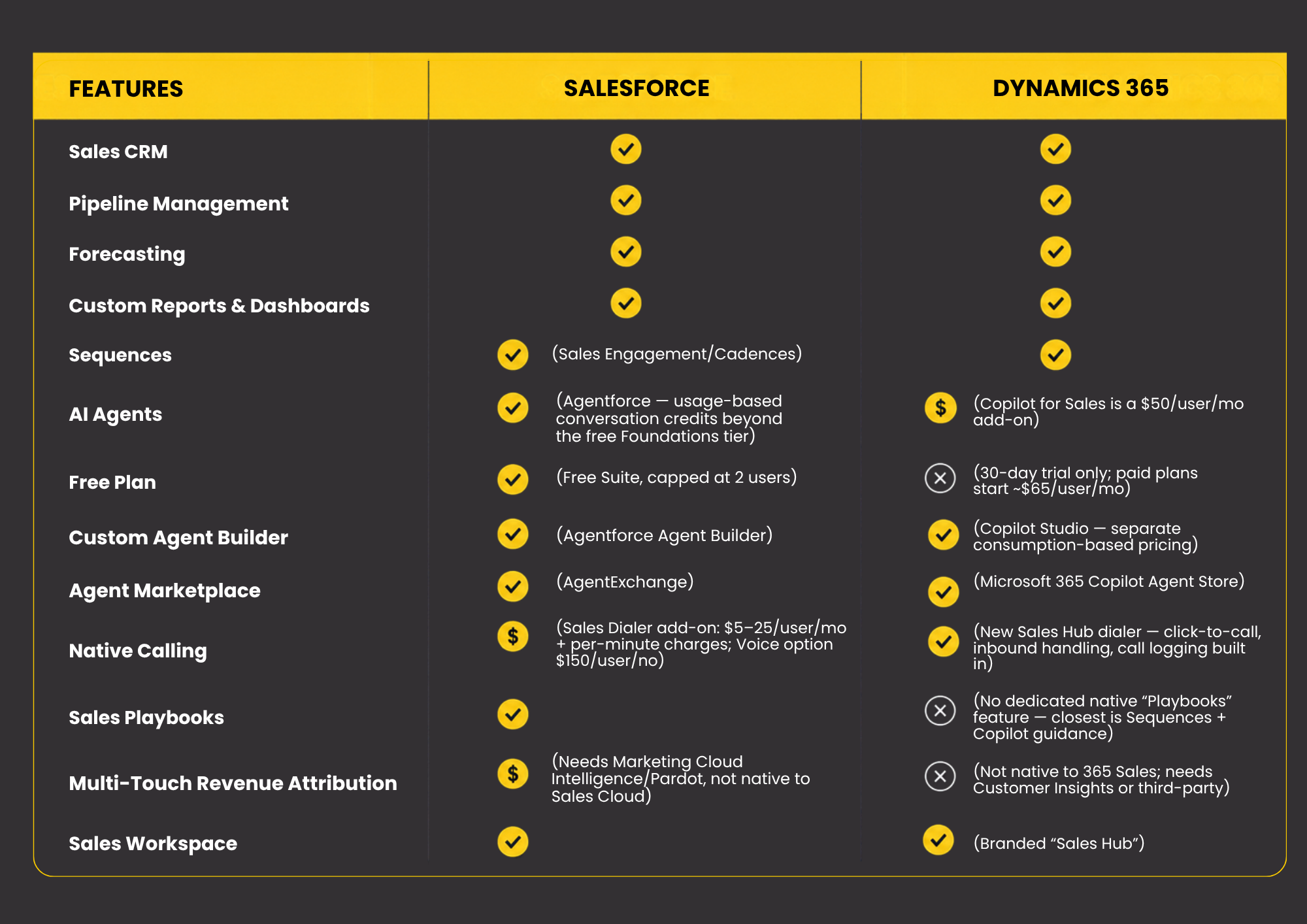
Salesforce has long been the dominant force in the CRM market. It’s built from the ground up as a CRM platform, with enormous depth across sales, service, and marketing (via Marketing Cloud). Its AppExchange marketplace gives you access to thousands of third-party integrations, and its AI layer – Einstein – has matured considerably. If your primary need is a best-in-class CRM with sophisticated marketing automation, Salesforce is hard to beat.
Microsoft Dynamics 365 takes a different approach. It’s part of the broader Microsoft ecosystem, sitting alongside Teams, Outlook, Azure, and the Power Platform. If your business already runs on Microsoft tools, the native integration is a genuine advantage – not a marketing claim. Data flows more naturally, user adoption tends to be easier, and licensing can be more straightforward when bundled with existing Microsoft agreements.
Where Salesforce Wins
- Purpose-built CRM depth across sales, service, and marketing
- More mature and configurable marketing automation
- Larger third-party app ecosystem (AppExchange)
- Stronger out-of-the-box reporting and analytics
- Broader adoption in B2C and retail environments
Salesforce was named a Leader in The Forrester Wave™: Revenue Marketing Platforms for B2B, Q1 2026, reflecting its strength in unifying customer data and orchestrating AI-driven campaigns across the revenue lifecycle.
Where Dynamics 365 Wins
- Native integration with Microsoft 365, Teams, and Azure
- Better value for businesses already paying for Microsoft licences
- Stronger ERP connectivity (Finance, Supply Chain, Business Central)
- Familiar interface for teams already using Microsoft tools
- More flexible modular pricing – pay only for what you use
Microsoft named a Leader in the 2026 Gartner® Magic Quadrant™ for CRM Sales Platforms for the sixteenth consecutive year.
Is D365 an ERP or CRM?
Dynamics 365 is both – or rather, it’s a suite of modular applications that covers CRM functions (Sales, Customer Service, Marketing) and ERP functions (Finance, Supply Chain, Business Central). You can deploy just the CRM modules, just the ERP modules, or combine them. This flexibility is one of its biggest strengths, but it also adds complexity when selecting and configuring the right modules for your needs.
This is an important distinction when comparing Salesforce vs Dynamics 365. Salesforce is a pure CRM and marketing platform – it doesn’t touch ERP territory natively. If your business needs CRM and ERP to work closely together (think order management, inventory, or finance data feeding into customer records), Dynamics 365 has a structural advantage. If you need a focused CRM with deep marketing capability, Salesforce is the more natural choice.
Salesforce vs Dynamics 365 for Marketing Teams
If you’re evaluating these platforms specifically for marketing, this is where the gap becomes clearest. Salesforce Marketing Cloud is a sophisticated multi-channel marketing platform with strong email, SMS, journey builder, and personalisation capabilities. It’s particularly well-suited to B2C businesses with large customer bases and complex lifecycle programmes.
Dynamics 365 Marketing (now part of Dynamics 365 Customer Insights – Journeys) has improved significantly but still lags behind Salesforce on marketing depth and flexibility. It works well for businesses with moderate marketing complexity, particularly if they’re already using Dynamics for sales and want a single unified platform.
For marketing teams looking at a full CRM platform comparison, it’s also worth considering whether either platform is the right fit at all. Platforms like HubSpot, Dotdigital, and Customer.io serve many marketing teams better than either of these enterprise giants – especially at mid-market scale. We’ve covered this in detail in our guide to the best CRM platforms on the market, which is worth reading alongside this comparison.
Who Is Salesforce’s Biggest Competitor?
Microsoft Dynamics 365 is Salesforce’s most significant enterprise competitor, particularly for large organisations. But in the broader CRM market, HubSpot has emerged as a formidable challenger – especially for mid-market businesses. Other notable competitors include Oracle CX, SAP CRM, and Zoho CRM at the SME end of the market.
The Salesforce vs Microsoft Dynamics rivalry is primarily an enterprise conversation. Both platforms carry enterprise-grade complexity and pricing to match. For smaller businesses or those with simpler CRM needs, the competition often comes from more accessible platforms. We’ve looked at some of those head-to-head comparisons elsewhere – including HubSpot vs Zoho and HubSpot vs Salesforce – if either of those is relevant to your evaluation.
What Will Replace Microsoft Dynamics?
Nothing is replacing Dynamics 365 in the near term – Microsoft is actively investing in it. The platform is evolving rapidly, with Copilot AI features being embedded across the suite and deeper integration with Microsoft’s Power Platform. The more relevant question for most businesses is whether Dynamics 365 will evolve fast enough to meet their needs, or whether a specialist CRM platform serves them better today.
Salesforce vs Microsoft Dynamics: Which CRM Is Right for My Business?
Here’s a straightforward way to think about it. Start with your existing technology. If your business runs on Microsoft 365, Azure, and Microsoft tools throughout, Dynamics 365 deserves serious consideration – the integration benefits are real and the total cost of ownership can be lower. If you’re starting fresh or your stack is more mixed, Salesforce’s CRM depth and ecosystem breadth often make it the stronger choice.
Then consider your marketing ambitions. If CRM-driven marketing – lifecycle campaigns, personalisation, multi-channel automation – is central to your growth strategy, Salesforce Marketing Cloud is the more capable platform. If marketing is a secondary function and you primarily need sales and service CRM, Dynamics 365 is a perfectly viable option.
Finally, think honestly about your team’s capacity to implement and manage either platform. Both require significant investment to configure properly. Both can become expensive, underused tools if they’re not resourced correctly after go-live. That’s a risk we see regularly – businesses investing in powerful CRM platforms and then not having the expertise internally to make them work.
| Factor | Salesforce | Microsoft Dynamics 365 |
|---|---|---|
| Best for | CRM-first, marketing-led businesses | Microsoft-embedded organisations |
| Marketing capability | Strong (Marketing Cloud) | Moderate (Customer Insights) |
| ERP integration | Via third parties | Native (Finance, Supply Chain) |
| Ecosystem | AppExchange (very large) | Microsoft ecosystem |
| Complexity | High | High |
Getting the Most From Either Platform
Choosing the right CRM platform is only half the challenge. The other half is making sure it’s implemented correctly, adopted by your team, and actually delivering the ROI your business needs. That’s where most CRM investments either succeed or quietly fail.
At WeDoCRM, we work with businesses across both platforms – and across HubSpot, Dotdigital, Customer.io, Iterable, and others. We’re not tied to reselling any single platform, which means our advice is genuinely about what’s right for you. Our insourced CRM consultancy model means we embed directly into your team rather than working from the outside – so we’re in your Slack, your sprints, your planning meetings, not sending deliverables over a wall and waiting for feedback.
Whether you’re mid-evaluation, already committed to a platform, or questioning whether your current setup is still the right fit, we can help you make sense of it. We’ve worked with brands from SMEs through to enterprise clients like Pearson and MoneySuperMarket, and we bring that breadth of experience to every engagement.
If you’re weighing up Salesforce vs Microsoft Dynamics and want an honest, platform-agnostic view of which CRM is right for your business, talk to our team at WeDoCRM. We’ll give you a straight answer – not a sales pitch for whichever platform we happen to partner with.
Frequently Asked Questions
Can a CRM agency help me choose between Salesforce and Microsoft Dynamics?
Yes – and it’s often the best way to approach the decision. A good CRM consultancy will assess your existing tech stack, team capability, marketing requirements, and budget before making a recommendation. The key is working with an agency that isn’t incentivised to push one platform over another. At WeDoCRM, we’re platform-agnostic, so our recommendations are based on what genuinely fits your business.
How much does it cost to implement Salesforce vs Dynamics 365?
Both platforms carry significant implementation costs beyond the licence fees. Salesforce implementations typically range from tens of thousands to hundreds of thousands of pounds depending on complexity. Dynamics 365 can offer better value for businesses already paying for Microsoft licences, but implementation costs are similarly variable. Budget for ongoing support and optimisation, not just the initial build – that’s where most businesses underestimate the investment required.
What if I already have a CRM but it’s not working well?
A CRM audit is usually the right starting point. Before migrating to a new platform, it’s worth understanding whether the problem is the platform itself or how it’s been configured and used. Many businesses find their existing CRM can deliver far more with the right setup and expertise behind it. If migration is the right call, we can help you plan and execute it properly – whichever platform you’re moving to or from.