
HubSpot vs Zoho CRM: Which Platform Is Right for Your Business in 2026?
If you’re weighing up HubSpot vs Zoho CRM right now, you’re probably not short of opinions – but you are short of clarity. Both platforms have strong reputations, both offer free tiers, and both promise to transform how your business manages customer relationships. The problem is that the right answer depends entirely on your situation. According to MarketsandMarkets research, the global CRM software market will reach USD 145.79 billion by 2029, growing at a CAGR of 12.5%. That growth shows just how many vendors are competing for your attention in 2026. This guide cuts through the noise.
Which CRM Is Better, HubSpot or Zoho?
HubSpot is better for teams that prioritise ease of use, marketing-led growth, and a polished user experience. Zoho CRM is better for businesses that need deep customisation, broad feature coverage at a lower price point, or tight integration with other Zoho apps. Neither is universally superior – the right choice depends on your team size, budget, and how you use your CRM day to day.
That said, there are meaningful differences that tend to push businesses one way or the other. HubSpot is widely regarded as one of the most intuitive CRM platforms available. Its interface is clean, its onboarding is well-structured, and its free tier is genuinely useful rather than a stripped-down teaser. Zoho, by contrast, is more feature-dense – sometimes to the point of feeling complex – but it rewards businesses that invest time in configuration.
Adoption is often the deciding factor. Research cited in Harvard Business Review’s CRM ROI case analysis highlights that CRM failure rates range from 30% to 70%, with poor adoption consistently cited as a leading cause. So before you compare feature lists, ask yourself: will your team actually use it?
HubSpot vs Zoho CRM: Pricing Compared
Pricing is one of the starkest differences in the HubSpot vs Zoho CRM comparison. HubSpot’s paid tiers scale quickly – the Starter plan begins at around USD 20 per month, but the Professional tier (where most serious marketing automation lives) starts at USD 890 per month. Zoho CRM’s Standard plan starts at USD 14 per user per month, with its Enterprise tier at USD 40 per user per month, making it significantly more affordable at scale.
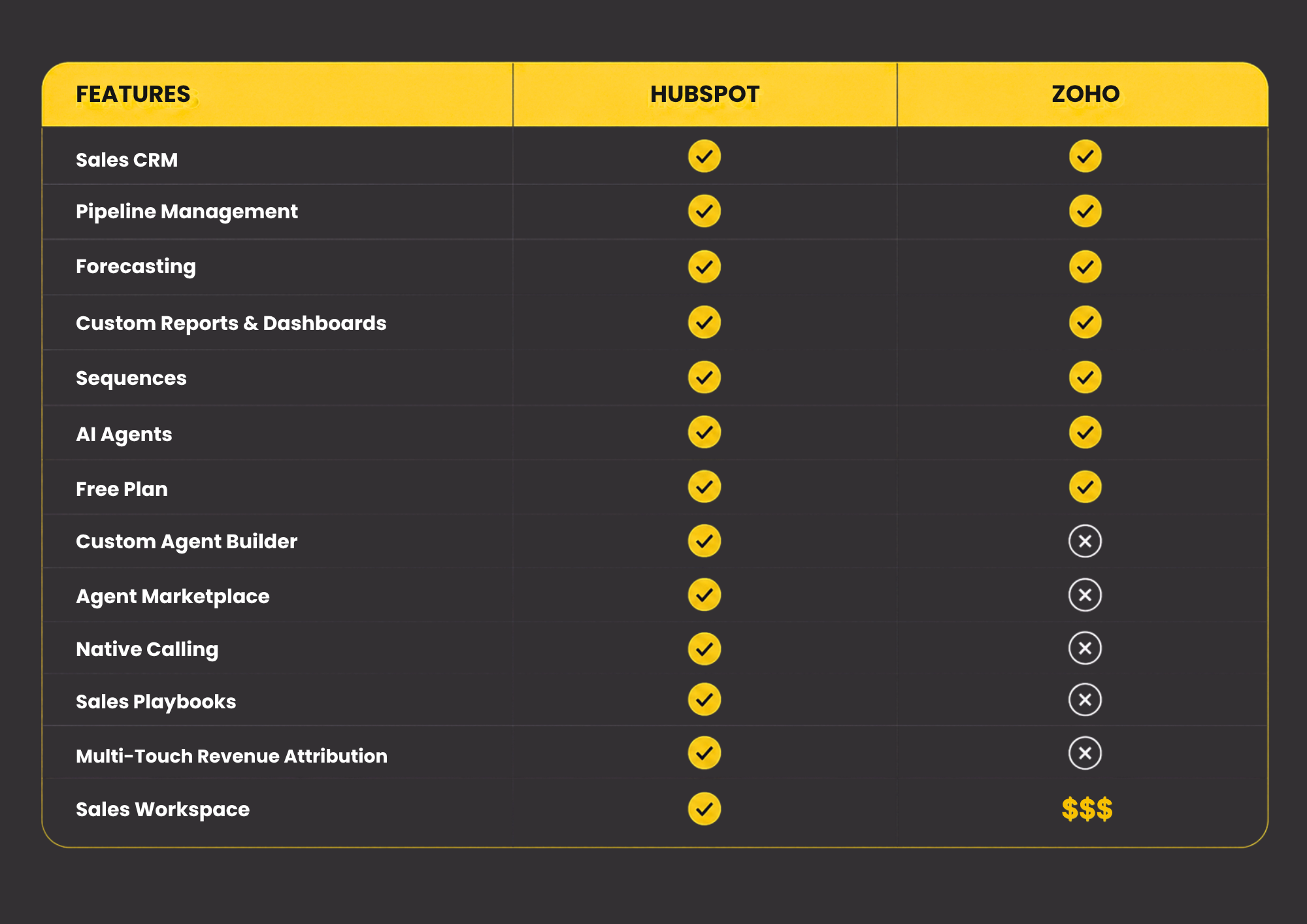
For smaller teams or businesses with tighter budgets, Zoho’s pricing model is hard to argue with. However, HubSpot’s costs often reflect a more integrated experience – you’re not just buying a CRM, you’re buying a connected marketing, sales, and service platform. Furthermore, the total cost of ownership includes implementation time, training, and ongoing support – areas where HubSpot’s usability can offset its higher licence fees.
Which CRM Is Better for Free – Zoho or HubSpot?
HubSpot’s free tier is stronger for most businesses. It offers unlimited users, deal pipelines, and core email tools with no time limit. Zoho’s free plan is capped at three users but suits very small teams already embedded in the Zoho ecosystem. If you’re evaluating free options alone, HubSpot wins on breadth – but Zoho’s free plan can be more than enough for a micro-team.
HubSpot vs Zoho
A side-by-side look at what each platform claims about itself
HUBSPOT
18%
more proactive than Zoho at delivering customer and process insights, according to customers.
76%
of sales professionals say HubSpot AI helps them spend more time selling.
ZOHO
HubSpot’s free CRM includes contact management, deal tracking, email templates, live chat, and basic reporting. That’s a genuinely useful starting point for a growing business. Zoho’s free plan covers contacts, leads, and basic automation – but the three-user cap means you’ll hit a ceiling quickly if your team grows. Additionally, Zoho’s more advanced features (like workflow automation and advanced analytics) are locked behind paid tiers on both platforms.
HubSpot vs Zoho: AI and Automation Features
HubSpot’s AI tools are built into its Breeze platform, offering content generation, predictive lead scoring, email optimisation, and AI-powered customer agents. Zoho counters with Zia, its proprietary AI assistant, which provides sales predictions, anomaly detection, and sentiment analysis. Both are capable – but HubSpot’s AI features tend to be more accessible out of the box, while Zia rewards deeper Zoho ecosystem investment.
For marketing teams in particular, HubSpot’s AI content tools are tightly integrated with its campaign workflows. You can generate email copy, suggest subject lines, and score leads without switching between tools. Zoho’s Zia, meanwhile, is genuinely impressive for sales intelligence – it can flag unusual drops in activity, predict deal closure probability, and recommend the best time to contact a prospect. The gap between them is narrowing, but HubSpot currently offers a more cohesive AI experience for marketing-led businesses.
Ease of Use, Mobile, and Support
HubSpot consistently scores higher for ease of use and user satisfaction. Its mobile app mirrors the desktop experience well and is widely regarded as one of the better CRM mobile apps available. Zoho’s mobile app is functional but can feel cluttered given the platform’s overall complexity. On customer support, HubSpot offers phone, email, and chat support on paid plans, while Zoho’s support quality is more variable – a common theme in user reviews across G2 and Capterra as of 2025.
HubSpot reports over 248,000 customers across more than 135 countries as of its most recent published figures, which reflects strong adoption at scale. That user base also means a large community, extensive third-party integrations, and a well-developed partner ecosystem. Zoho, by contrast, has over 100 million users globally across its broader suite of business apps – though its CRM-specific user base is smaller than HubSpot’s.
Key Differences at a Glance
| Feature | HubSpot | Zoho CRM |
|---|---|---|
| Free tier | Unlimited users, strong features | Up to 3 users, basic features |
| Paid pricing (entry) | From ~USD 20/month | From ~USD 14/user/month |
| Ease of use | High – intuitive UI | Moderate – feature-dense |
| AI tools | Breeze AI (content, scoring) | Zia (sales intelligence) |
| Customisation | Moderate | High |
| Mobile app | Strong | Functional but complex |
How to Choose Between HubSpot and Zoho CRM for Growth
The best way to choose between HubSpot and Zoho CRM for growth is to map each platform against your team’s actual workflows, not just your feature wishlist. HubSpot suits marketing-led, fast-growing businesses that value speed-to-value and usability. Zoho suits technically confident teams that need deep customisation and broad functionality at a lower cost. Neither platform delivers ROI without proper implementation and adoption.
If your primary growth driver is inbound marketing and you want your CRM, email, landing pages, and analytics in one place, HubSpot is the more natural fit. Its platform is built around the marketing funnel, and consequently, it tends to deliver faster results for teams without dedicated technical resource. Zoho, however, is the stronger choice if you need granular control over data fields, complex automation logic, or tight integration with finance, HR, or operations tools – particularly if you already use other Zoho products.
Either way, the platform itself is only part of the equation. Implementation quality, data hygiene, and team adoption determine whether a CRM becomes a genuine revenue driver or an expensive contact database. That’s where expert CRM consultancy makes the difference.
What CRM Is Better Than Zoho?
HubSpot is often cited as a better alternative to Zoho for businesses that prioritise usability and marketing integration. Salesforce leads for enterprise complexity and customisation. For mid-market businesses, platforms like Customer.io or Iterable can outperform Zoho in specific use cases like lifecycle marketing. The best CRM is the one your team will actually use – and that’s configured to match your customer journey.
It’s worth noting that “better” is always relative to context. Zoho outperforms HubSpot on price-to-feature ratio for many businesses, particularly those with complex sales processes or existing Zoho infrastructure. However, if Zoho’s complexity is creating friction – and therefore low adoption – then a platform with a gentler learning curve may deliver stronger ROI in practice, even if it costs more on paper.
Getting the Most from Your CRM Platform
Choosing between HubSpot vs Zoho is genuinely important. But the bigger risk isn’t picking the wrong platform – it’s picking the right one and implementing it badly. Poor configuration, dirty data, and low adoption will undermine either system. That’s precisely why more businesses are turning to a dedicated CRM consultancy rather than trying to manage it alone.
With so many CRM platforms competing for attention, choosing the right one can feel overwhelming. If you’re still weighing up your options, take a look at our guide to the 5 best CRM platforms on the market, where we compare the leading platforms and what they’re best suited to.
At WeDoCRM, we work as an extension of your team – not as an external agency that disappears between briefs. Our consultants embed directly into your workflows, so you get senior-level CRM and MarTech expertise without the cost or commitment of a full-time hire. We’re platform-agnostic, which means we recommend what’s right for your business, whether that’s HubSpot, Zoho, Salesforce, Dotdigital, or something else entirely. We are partnered with them all.
If you’re ready to get more from your CRM platform – or you’re still deciding which one to choose – We’ll help you make the right call and make it work.
Frequently Asked Questions
Is HubSpot or Zoho easier to set up and use?
HubSpot offers a quicker, simpler setup, especially for marketing teams without dedicated technical support. Its intuitive interface, structured onboarding and accessible core features help teams get started with minimal configuration. Zoho gives businesses greater flexibility, but teams need to invest more time in setup and training to get the most from the platform.
Can I migrate from Zoho to HubSpot (or vice versa) without losing data?
Yes – migrating between Zoho and HubSpot is technically achievable, but it requires careful planning around data mapping, field matching, and deduplication. A poorly managed migration can result in data loss, duplicates, or broken automations. Working with an experienced CRM consultancy significantly reduces that risk and ensures continuity throughout the process.
Do I need a CRM agency to implement HubSpot or Zoho CRM?
You don’t strictly need one, but the data suggests it helps. With CRM failure rates ranging from 30% to 70% according to widely cited Gartner research, having expert support during implementation and adoption dramatically improves your chances of success. A CRM agency can also ensure your platform is configured to drive real business outcomes, not just store contact records.