
If you’re a sales or marketing leader, there’s a good chance you’ve been defending a CRM / ESP investment while quietly wondering why it isn’t fixing your revenue problems. Instead of a lovely system boosting your profits and making everything easier, it’s actually been frustrating with underwhelming metrics and teams that don’t want to use it. Doh!
It’s easy to blame the tech. And to be fair, when you’re spending somewhere between £15,000–£80,000 a year, you expect it to deliver. But here’s the reality: 66% of sales reps feel more overwhelmed than empowered by their CRM.
That’s the first red flag.
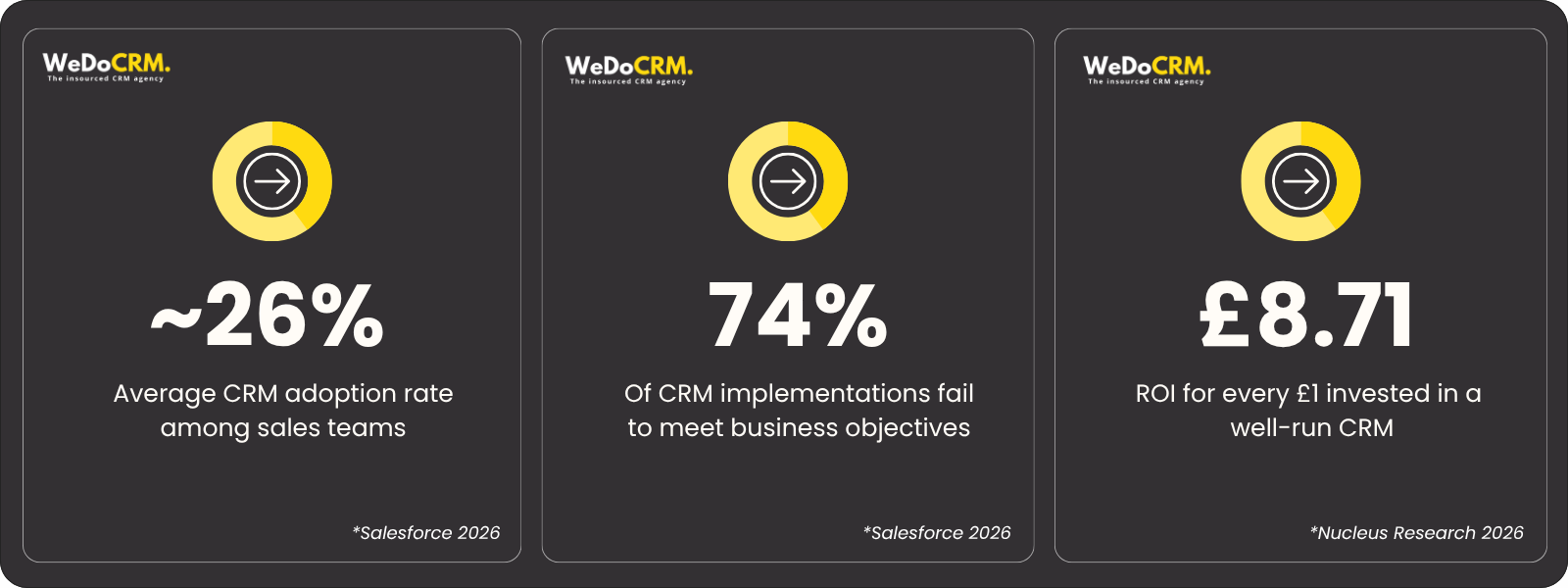
The second? Adoption. On average, only around 26% of sales teams actually use their CRM properly. And it gets worse, 74% of CRM implementations fail to meet business objectives. (Salesforce)
So no, it’s probably not the software. It’s actually a strategy problem.
“Buying a CRM is like buying a gym membership. The machine doesn’t get you fit. What do you do with it does.” – Vanessa Mallia (Head of Growth at WeDoCRM)
When it’s done right, the difference is huge. A well-run CRM delivers an average of £8.71 for every £1 invested. That stat is worth sitting with.
Because if yours isn’t doing that… It’s not broken, but it’s definitely not pulling its weight.
So what’s actually going wrong? Here are the most common reasons CRMs fail to perform, even when the budget is substantial.
Why Your CRM Isn’t Performing
Every one of these has a direct line to revenue leakage.
| Issue | What It Means |
| Low adoption | It’s not being used properly, so the data isn’t reliable. |
| Poor data quality | Outdated or incomplete data leads to poor decisions. |
| No clear process | The CRM doesn’t reflect how your team actually works. |
| Teams are siloed | Sales and marketing aren’t aligned or sharing information. |
| No ownership | No one is responsible for managing or improving the system. |
Some of the Causes Why and The Real Effects
1. Low Adoption = Inaccurate Forecasting
The “I’ll update it later” problem or “I prefer using a spreadsheet” problem. If the system is not being used properly, leadership is simply going to be making decisions based on, well, pure optimism. It’s not reliable.
How to fix it:
Make it easier to use by simplifying fields, reducing admin, and showing reps how it actually helps them close deals, not just track them. We recommend putting in training for the team, too.
2. Poor Data Quality = Based on Bad Data
The dirty data has no one responsible for cleaning it. What we mean by cleaning is getting those duplicates, outdated companies, blank key fields and contacts assigned to reps who left the company 18 months ago organised!
How to fix it:
Run a data clean-up, set mandatory fields, and assign someone to own data quality going forward.
3. No Clear Processes = Wrong Message, Wrong Audience
This is where there is no segmentation, and everyone is getting the same treatment. A CFO considering a £50K contract and a freelancer on a trial plan should definitely NOT be receiving the same email. Your sender reputation will take a hit that will cost you for months to rebuild.
How to fix it:
Map your customer journey properly and build segmentation around behaviour. Different actions should trigger different messages.
💡 If you want to see how segmentation works in practice, take a look at our guide on how to segment and target your customers through CRM.
> How to Segment and Target your Customers through CRM
4. Teams are Siloed = Wasted Spent, Duplicated Effort
We see this all the time, where sales and marketing operate in separate universes.
Marketing generates leads… Sales ignores half of them…. Feedback never flows back… Marketing keeps optimising for the wrong thing. There needs to be communication and teamwork.
How to fix it:
Take a hard look at your system and agree on what a qualified lead looks like, set clear handover points, and create a feedback loop so both teams stay aligned.
5. No Ownership = Missed Follow-ups and Lost Deals
This is where automation comes in really handy. Manual follow-ups get missed, and leads go cold, nurture sequences don’t exist or go at the wrong time. Every hour a team spends on repetitive admin tasks, they are not selling.
How to fix it:
Assign a clear CRM owner and introduce automation for follow-ups and nurturing, so nothing gets missed.
What These Problems Are Actually Costing You
- Low adoption → Missed targets
- Poor data → Wasted spend
- No clear process → Lost conversions
- Siloed teams → Missed opportunities
- No ownership → Lost deals
Self-Diagnosis: Is Your CRM Actually Working?
Before you consider switching platforms or throwing more budget at the problem, run through this quick checklist. Be honest.
CRM Health Check: tick what’s true for your business:
☐ Our sales team logs activities within 24 hours
☐ We have automated follow-ups for new leads (not just manual tasks)
☐ Contacts are segmented and actually receive different journeys
☐ Sales and marketing agree on what a “qualified lead” means
☐ We regularly A/B test emails (subject lines, CTAs, send times)
☐ Someone clearly owns CRM health (data, workflows, support)
☐ Our pipeline reflects how customers actually buy
☐ We can see which campaigns drive revenue in real time
Scored yourself?
5 or more ticks? – you’re on the right track (but there’s always room to optimise)
Fewer than 5? – there’s untapped potential… and likely revenue being left on the table.
Talk to the people who use it every day. You’ll often find that the gap isn’t as expensive to close as you’d feared! It just requires someone with the right expertise (cough, us.. cough) to close it.
💡Let’s take a proper look at it. Our CRM Audit shows you what’s broken, what’s being ignored, and what’s quietly costing you money.
What Good Actually Looks Like
When a CRM is working properly, it stops being a system people use reluctantly and starts being a system they’d be lost without. Here’s what clients typically see after a structured CRM overhaul:
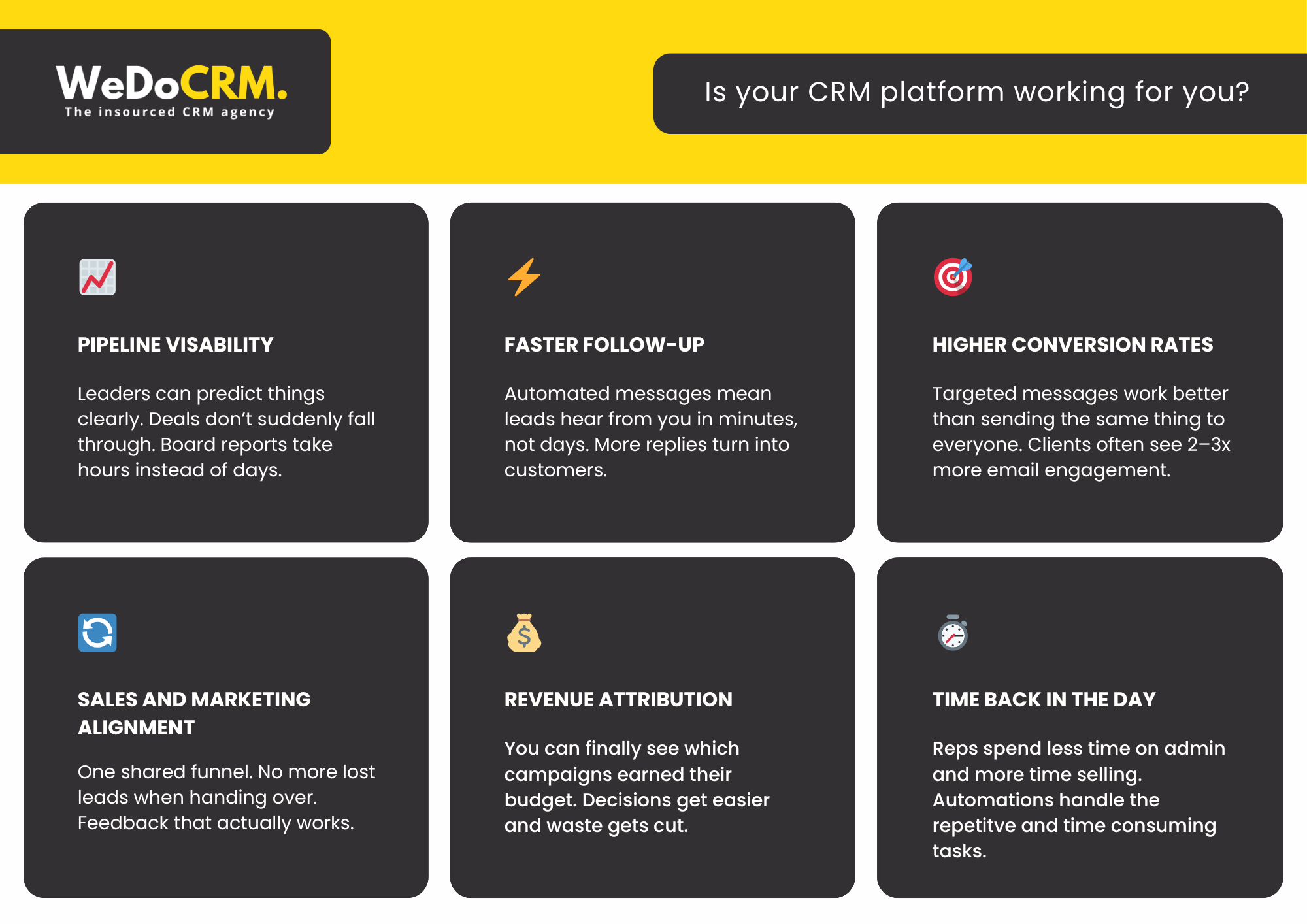 When your CRM is working properly, everything feels easier and more predictable.
- Sales reps actually use it (because it helps them)
- Data is clean, so decisions are confident
- Leads are followed up on instantly, not eventually
- Marketing knows what converts (and what doesn’t)
- Revenue can be traced back to specific campaigns
It stops being a system you tolerate… and starts being one you rely on.
Frequently Asked Questions – Underperforming CRM Platform
These are the questions we hear most often…
Why is my CRM not improving sales performance?
Most CRM underperformance comes down to one of five issues: low adoption, poor data quality, misaligned pipeline stages, lack of automation, or a disconnect between sales and marketing. The platform itself is rarely to blame. A structured audit will identify which of these is the root cause in your business.
How long does it take to fix a poorly performing CRM?
We would say go for the quick wins! This is a data cleanse, pipeline rebuild, and core automations, which are typically achievable in 4–8 weeks. Deeper strategic change, including sales-marketing alignment and reporting infrastructure, usually takes 3–6 months. The first improvements in conversion and follow-up speed often show up within the first 30 days.
Should I switch CRM platforms or fix my current one?
You really don’t need to switch… unless you are severely unhappy. The same strategy problems that hurt you on your current CRM will follow you to a new one, just with added migration costs. Our recommendation is always to audit first.
What is a good CRM adoption rate?
Industry benchmarks suggest 75%+ adoption is needed before a CRM reliably improves revenue outcomes. Below that, data quality suffers too much to support meaningful decision-making. If your team is logging activities inconsistently, that’s where we recommend starting. As we mentioned, the technology problem is usually a people and process problem in disguise!
How do I measure CRM ROI?
Track revenue influenced by CRM-driven activities (emails, sequences, automations), time saved on admin per rep per week, pipeline conversion rates by stage, and lead response time. Compare these metrics before and after any changes.
Can CRM automation replace my sales team?
No and no again, that’s not what it’s for. The best automation handles the repetitive and time-consuming tasks, so the: initial lead response, follow-up reminders, nurture sequences, and onboarding emails. This frees your salespeople to do the one thing automation can’t: build human relationships that close high-value deals.
How WeDoCRM Can Help You
High CRM spend with underwhelming results isn’t rare; we see it constantly!
Customer Story
How WeDoCRM unlocked Old Gold Racing’s potential through a CRM audit. The first racing syndicate with a dedicated mobile app and a CRM strategy to match.
> Read more: Unlocking Old Gold Racing’s Potential Through a CRM Audit
Whether you’re struggling with low conversions, poor engagement, or journeys that just aren’t delivering, we’ll show you exactly what’s not working and how to fix it.
Book a discovery call, and we’ll walk through your current setup, highlight where you’re losing revenue, and what you can do about it.
Or drop us a message at sales@wedocrm.co
Want more insights? Check out:
- Why WhatsApp Marketing is Powerful – Check out other ways to do marketing
- Inside HubSpot’s AI Strategy 2026 – Take a look at the rise of their AI tool Breeze