
According to a recent article in The Wall Street Journal, around 23 % (about $20 billion) of online ad budgets are wasted each year.
Too many marketing teams are throwing money into campaigns without knowing which ones actually work. PPC, paid social, email, affiliates and so forth, they all generate reports, the dashboards claim credit for the same conversion, and when leadership asks which channel drives revenue, the answer is often unclear.
We’ve previously highlighted eye-watering paid media spends. Unilever alone spent $194 million on Google PPC in a year, and a poorly set-up CRM can waste that investment (spend without strategy is just spend).
You can read more about this here – $194 Million on PPC, but Who Actually Owns the Data?
We’re about to show you how to optimise your marketing spend with clean tracking, smart strategy, and insights from our CRM and marketing experts who’ve all been there, done that, and made the mistakes, so you don’t have to!
1. Know what you’re measuring and how to capture it properly
Before you can optimise marketing spend, you need to be clear about what success actually looks like for each channel. What does success look like to you? Every business is different. For example, clicks are not customers, impressions are not revenue, and strong cost-per-click means very little if those people clicking never actually convert.
The first step is agreeing on the metrics that genuinely connect to business outcomes. What is important to you?
Ask yourself:
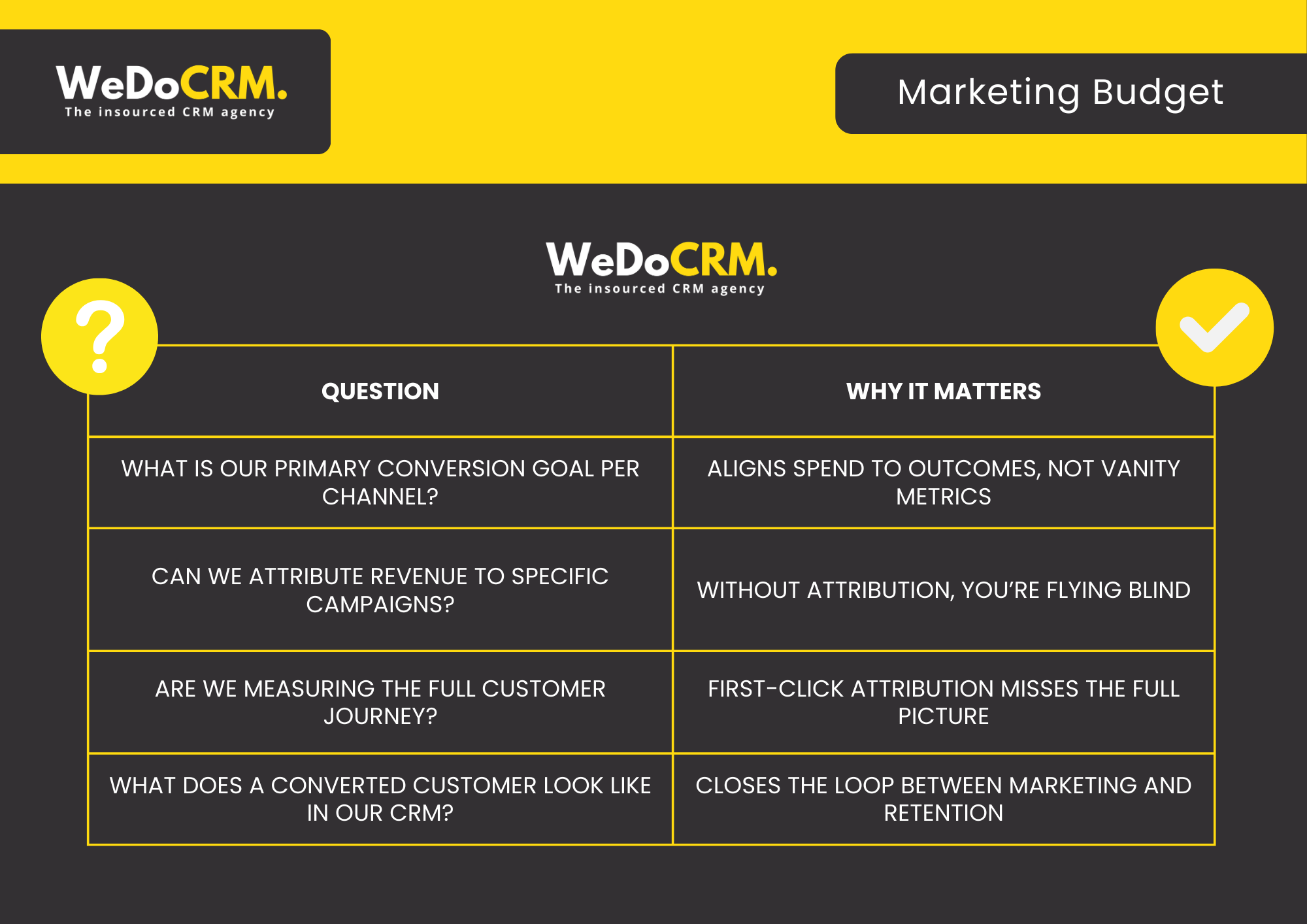
| Question | Why It Matters |
| What is our primary conversion goal per channel? | Aligns spend to outcomes, not vanity metrics |
| Can we attribute revenue to specific campaigns? | Without attribution, you’re flying blind |
| Are we measuring the full customer journey? | First-click attribution misses the full picture |
| What does a converted customer look like in our CRM? | Closes the loop between marketing and retention |
If these questions are hard to answer, your data is likely fragmented across multiple platforms. When marketing data lives in separate tools, it becomes difficult to see which campaigns are actually driving revenue.
The solution is connecting your marketing channels to your CRM/ESP platform and making sure every lead is tracked properly, and here’s how.
For example:
- PPC campaigns: Add UTM parameters to your Google Ads links so when someone fills out a form, your CRM records that the lead came from Google Ads, etc.
- Paid social: If someone downloads a guide from a LinkedIn ad, that source and campaign name should be captured automatically in your CRM when the lead is created.
- Email marketing: When a subscriber clicks a nurture email and later purchases, your CRM should still recognise that email campaign as part of the journey.
- Partnerships or affiliates: Track referral links so you can see which partners are actually bringing in customers rather than just traffic.
When this data flows into your CRM, you can clearly see which campaigns generate leads, which ones convert into customers, and which channels actually drive revenue. Once you have that visibility, optimising marketing spend becomes much easier.
2. Treat PPC as a tool instead of a strategy
Paid media is amazing at generating demand, but it’s awful at building anything that lasts. We’ve mentioned before in previous articles that once you become reliant on PPC, it’s so difficult to break the cycle, turn it off, the leads stop… pause it, and your competitors fill the gap, it’s not an easy ride at all!
It still doesn’t mean you shouldn’t use it, though; it just means you need to think about what it’s for and what happens after the click.
Every £1 you spend on paid media should be doing so much more than driving a click! The click should at least be going into your CRM platform, capturing the data and creating a relationship long after the campaign ends; otherwise, you are simply just spending money.
Our question to you is, if you switched off your paid media tomorrow, how long would your pipeline last?
So, what should you do next?
Make sure your paid media and your CRM are actually connected, which brings us to our next point.
3. Get your CRM talking to your MarTech stack
Most CRM platforms, whether you’re on HubSpot, Salesforce, or something like Iterable or Dotdigital, have native integrations with the major ad platforms. That means you can connect Google Ads, Meta, and LinkedIn directly to your CRM and start passing data between them.
What we recommend:
- Suppression lists: sync your existing customers from your CRM into your ad platforms so you’re not paying to advertise to people who’ve already bought. Simple, but so often overlooked.
- Lead source tracking: Make sure every contact that enters your CRM has a source attached to it. Which campaign did they come from? Which ad? Which keyword? Without this, you’re guessing at what’s working.
- Closed-loop reporting: once a lead converts into a customer, that data should feed back into your ad platforms. This tells Google or Meta what a good conversion actually looks like, and lets their algorithms optimise toward more of the same.
If you’re not sure whether your CRM platform is set up to do any of this, that’s worth finding out because the gap between a connected stack and a disconnected one isn’t a small one.
That’s the kind of thing we help with at WeDoCRM. We spend our days untangling CRM setups, connecting the dots between platforms, and making sure your marketing and sales teams are working from the same playbook (and the same data).
Drop the WeDoCRM team a message, and we’ll happily take a look!
Marketing Budget FAQ’s
What’s the most common marketing budget mistake?
Trying to do everything, everywhere, all at once. Spreading your budget across ten channels usually means none of them gets enough investment to work properly.
Should the marketing budget stay fixed all year?
Not really. Smart teams move budget around based on performance. If something’s working, double down. If something isn’t, stop throwing money at it and hoping for the best.
What’s the difference between a marketing budget and an advertising budget?
Think of advertising as one slice of a big pie. A marketing budget segment includes ads, but also things like content, email marketing, CRM platforms, design, events, and analytics. Advertising gets attention, marketing turns that attention into customers.
What happens when marketing budgets get cut?
Often, the first thing to go is brand awareness activity. The irony is that when companies stop marketing during tougher times, they can become less visible just when they need customers the most!
How much should we spend on marketing?
It depends! Many businesses spend 5–10% of revenue, while startups or growth-stage companies often invest 10–20% or more to build awareness fast. The key is spending smart, not just big.
Want more of our insights? Check out:
- Make Your CRM Budget Work Harder This Financial Year – Tips from our CEO
- Why Businesses Are Exploring Alternative CRM Platforms – What CRM Platform is best for you?
- Email Marketing Trends – Find out about the latest trends