
How to Fix a Failing CRM Implementation
CRM systems are designed to make every business run like a well-oiled machine, with better data, stronger relationships, and higher revenue. The dream.
But somewhere between the sales pitch and the launch/go-live data, things can go sideways, and instead of this wonderful system you were promised, you’ve got a CRM system your team avoids, data you don’t trust and spreadsheets quietly making a comeback in the background. Just no.
Just because this is happening, do not worry, it doesn’t mean you’ve made the wrong decision here; it means something went wrong along the way, and the good news is that it is fixable!
Having recently helped clients with CRM migrations and implementations, we’ve gathered a few lessons worth sharing… ideally before you’re tempted to launch your laptop out the window and declare your CRM the most expensive mistake you’ve ever made.
CRM Implementation: The Fast Facts
| Failure Rate | About 55% of CRM projects don’t achieve what they were supposed to. |
| Average Goal Shortfall | On average, over half (51%) of the expected benefits of a CRM platform never happen. |
| Budget Overruns | Around 63% of CRM projects go over budget, often by 30–49%. |
| Timeline to Recovery | With the right fixes, things can improve in 3–6 months, but it usually takes 12–18 months to see a full return on investment. |
| Delayed Roadmap | A failed CRM can push your entire technology strategy back by 12–24 months (let’s hope we can fix that) |
| ROI When Done Right | Properly implemented CRMs deliver up to 245% ROI over three years |
Sources from (Gartner & Forrester)
How to Fix a Failing CRM Implementation
Knowing your CRM is struggling is one thing. Knowing where to start fixing it is another. Most implementations follow predictable failure patterns, which means the recovery path is more straightforward than it feels when you’re in the middle of it. It’s time to start with an honest checklist.
The Honest CRM Implementation Checklist
Before you touch a single setting or retrain a single team member, get honest answers to these questions. They’ll tell you exactly how deep the problem goes. Are you ready to truly be honest with yourself here? Grab a pen and paper.
| Question | Why It Matters | |
| 1 | Is your team actually using the CRM daily? | Low adoption is the number one killer! |
| 2 | Do you trust the data in your CRM right now? | Bad data makes every decision downstream worse |
| 3 | Can you pull a meaningful report in under 5 minutes? | If not, your setup is working against you |
| 4 | Does every user know exactly what they’re supposed to log and when? | Inconsistency kills data quality faster than anything |
| 5 | Is your CRM connected to your other key tools? | Siloed systems create siloed data and siloed teams |
| 6 | When was the last time someone reviewed your pipelines and automations? | Outdated workflows quietly sabotage results |
| 7 | Do you have a named person responsible for CRM health? | No ownership means no accountability (and no progress!) |
If you answered “no” or “not sure” to three or more of these, you’re dealing with a structural problem that needs a structured fix. That’s okay, as we mentioned, it’s fixable, and we’ve got some tips below to help you do just that.
The CRM Implementation Rescue Framework: 4 Phases
Recovery doesn’t happen all at once. It happens in the right order. Here are some insights from the framework we use here at WeDoCRM that actually work:
Phase 1: Diagnose
Don’t start fixing things before you know what’s actually broken. This phase is about getting a clear, honest picture.
| Action | What to Do |
| Audit adoption | Time to investigate and look who’s logging in regularly, who isn’t, and whether the information in the CRM is actually being kept up to date. |
| Talk to your team | Ask those using it what’s frustrating them. Talk to your team and take what they say on board, as they are the ones who need to use it |
| Map the gaps | Make a list of where the CRM was supposed to help and where it’s currently falling short |
By the end of this, you should have a prioritised list of what’s broken, ranked by business impact.
Phase 2: Stabilise
Before you build anything new, focus on quick wins that rebuild trust in the system.
| Action | What to Do |
| Clean the data | Remove duplicates, standardise fields, and archive old or unused records. |
| Simplify the setup | Remove unused pipelines, fields, and automations; less is more |
| Establish clear ownership | Assign a CRM owner who is responsible for ongoing health |
| Set basic standards | Define what must be logged, by whom, and when — and make it simple |
By the end of this, you should have a much cleaner, leaner system that people can actually trust enough to use!
Phase 3: Get Your Team Using the CRM (CRM Adoption)
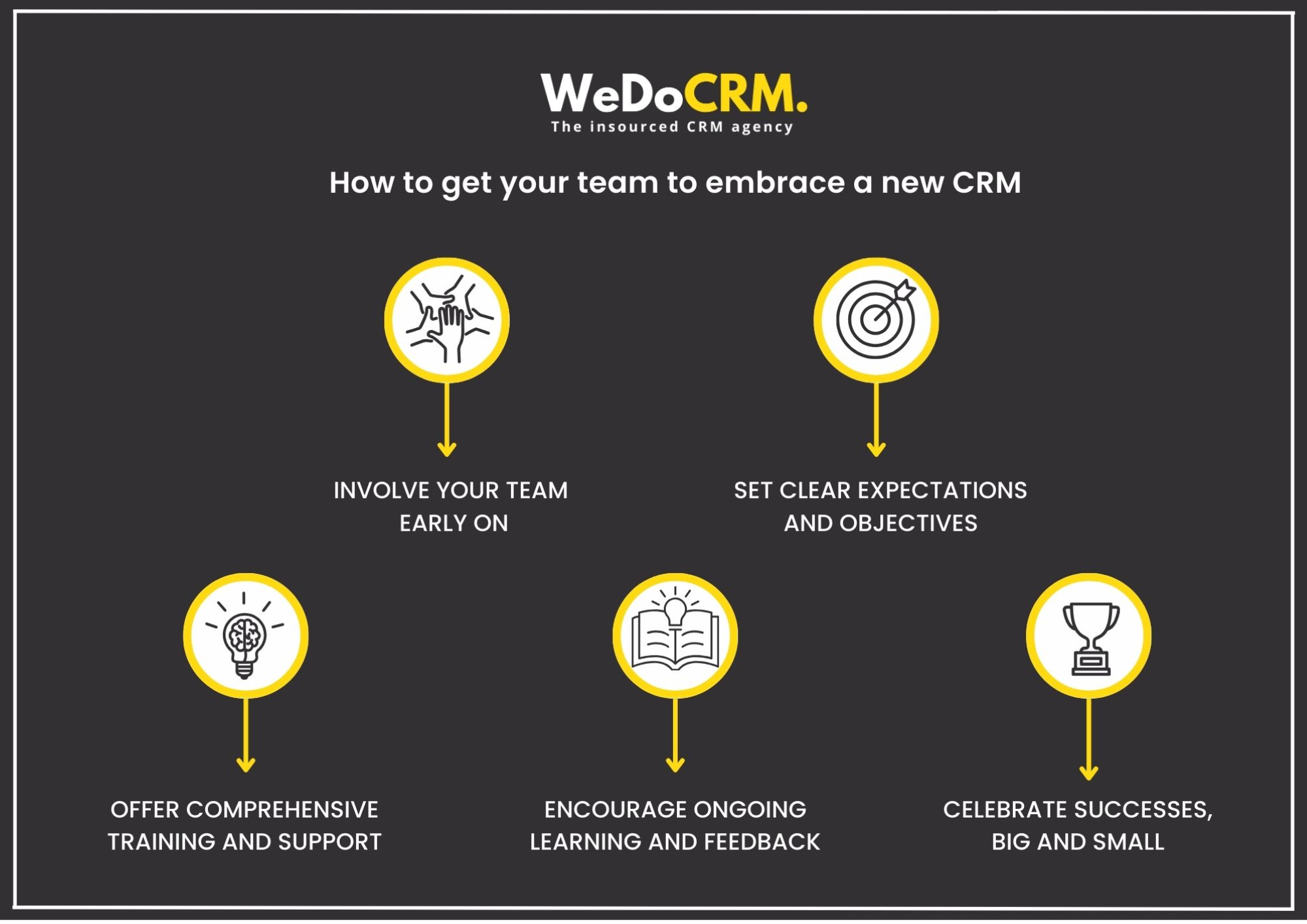
Technology problems are rarely technology problems. This phase fixes the people side, which is where most implementations were lost in the first place. Over 70% of CRM projects fail because different teams aren’t aligned on how the system should be used. So let’s change that.
| Action | What to Do |
| Retrain your team properly | Not just a quick walkthrough, you have to give role-specific training based on real tasks people do every day |
| Show the value of the CRM platform | People are much more likely to use a system if it clearly makes their job easier, so show them the benefits |
| Get leadership using it | If managers and leaders use the CRM, the rest of the team will follow |
| Create feedback loops | Give users an easy way to share issues or suggestions and act on what they say |
By the end of this, you should have a team that uses the CRM because it helps them, not because they’re told to.
Phase 4: Optimise
The hard part is done. Your data is clean, and your team is actually using the system. Now comes the good and exciting bit, turning a working CRM into a genuinely powerful business tool!
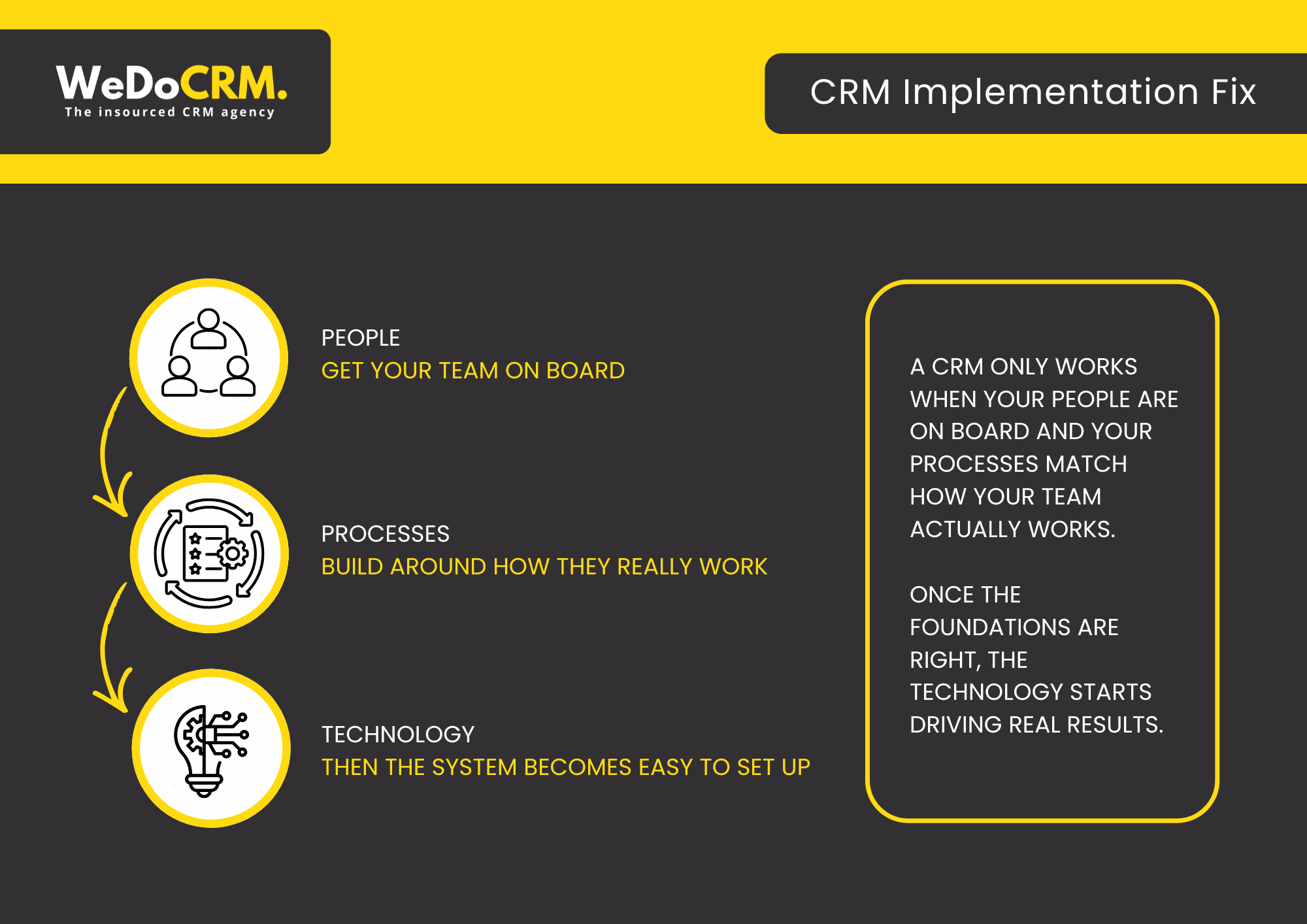
This is usually where we come in. Once the foundations are solid, the conversation shifts from fixing problems to driving results. And that’s exactly what we’re here for.
Below are some of the services we offer and links so that you can see them in action.
| CRM Support | What We Do |
| Rebuild automations | Smart, purposeful workflows built around how your team actually operates (Lifecycle Automation Journeys) |
| Connect your stack | Integrate your CRM with marketing, support, and finance tools for a single customer view (MarTech Development) |
| Build better reporting | Dashboards tied to real decisions, not vanity metrics nobody acts on (CRM Strategy) |
| Monthly health checks | Catch drift early, keep adoption high, keep performance moving (Insourced CRM Support) |
How WeDoCRM Can Help You
We’re not here to sell you a platform and wave you off at go-live. We’re here to make sure your CRM becomes one of the most valuable tools in your business properly implemented, properly adopted, and properly optimised for the way you actually work.
Whether you’re starting from scratch, rescuing something that went sideways, or ready to take a stable system to the next level, we can help.
Get in touch. Let’s make your CRM work the way it was always supposed to.
Want more insights? Check out:
Holiday CRM Insights for Personalised Marketing
Why WhatsApp Marketing is Powerful – Check out other ways to do marketing