
Agentic AI in Marketing and CRM Explained
AI, AI and AI, yes, we know – another AI article. We can hear your collective groan from here. But hear us out. This one’s actually a good one (promise!).
Welcome to 2026: the year agentic AI stops being hype and starts being… well, everywhere. (Cue dramatic music. Or maybe the Jaws theme. We haven’t decided yet.)
Agentic AI has properly stepped into that spotlight and become mainstream focus, moving into something super dooper useful, maybe even world domination? (too far? Perhaps, anyway, it would be the helpful kind!) Gartner Predicts Agentic AI will autonomously resolve 80% of common customer service issues without human intervention by 2029 (so that’s pretty cool.)
It’s not brand new. Early versions have been quietly doing their thing for a few years now. The difference is that this is the year it stops being something people talk about and starts being something businesses actually use successfully.
And when it comes to marketing and CRM, that’s where things start to get really fun. (Slightly terrifying, too, but mostly fun!)
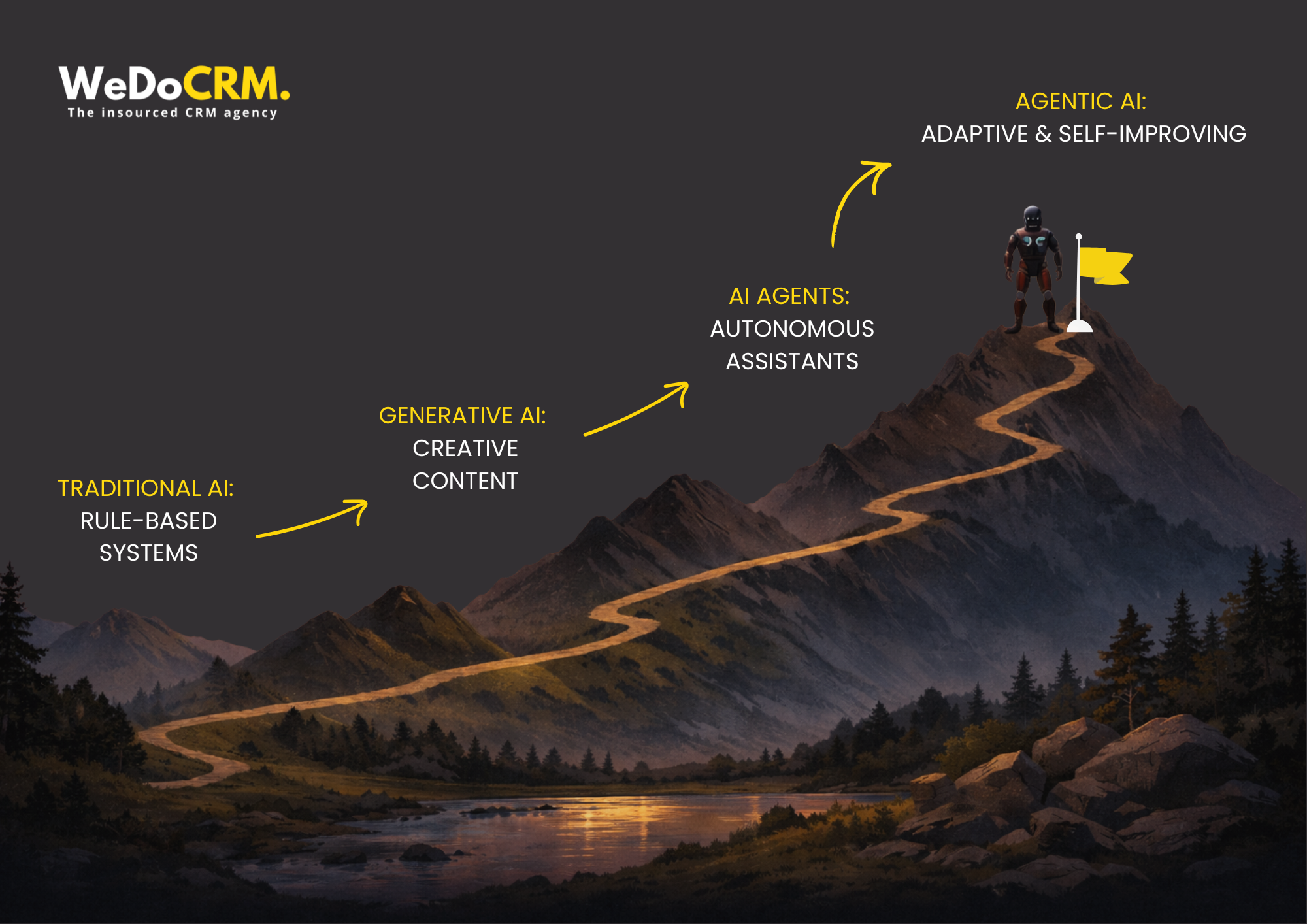
The AI Evolution in Marketing and CRM
| Stage | What It Does | CRM/Marketing Example |
| 1. Traditional AI | Analyses data and makes predictions based on patterns | “This lead is 85% likely to convert” (but you still have to call them) |
| 2. Generative AI | Creates content and makes suggestions | “Here’s a personalised email draft for this customer” (but you still have to review and send it) |
| 3. AI Agents | Uses tools and can handle multi-step tasks | “I’ve drafted the email, scheduled it, and will follow up if they don’t respond” (but you still need to approve it) |
| 4. Agentic AI | Plans, reasons, and acts autonomously toward goals | “I’ve identified at-risk customers, created win-back campaigns, launched them, and I’m now optimising based on results” (all while you were in that meeting) |
What is Agentic AI in Marketing?
Traditional AI tells you what to do. Agentic AI actually does it.
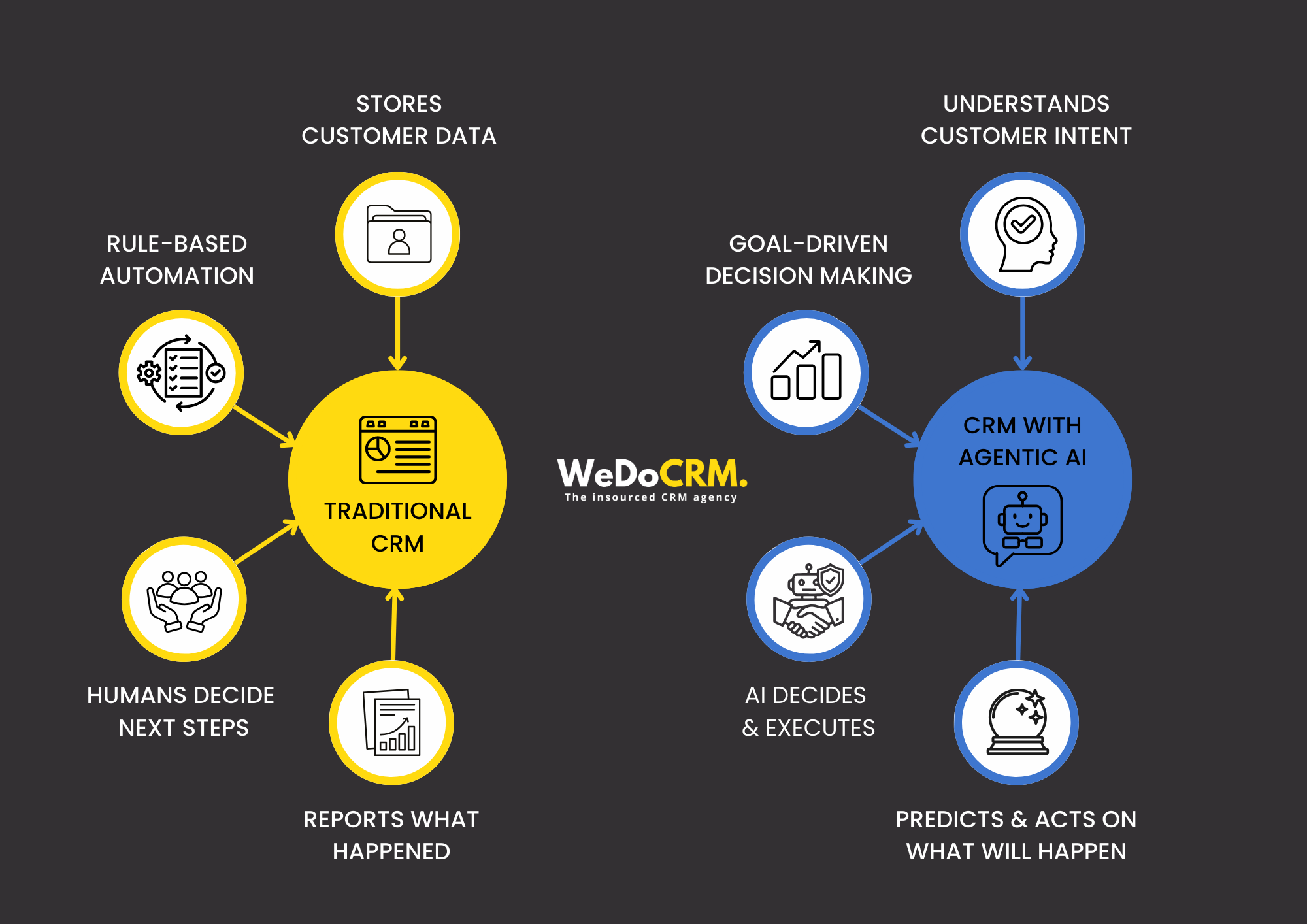
It’s AI that can set its own sub-goals, make decisions, use multiple tools, learn from outcomes, and course-correct without needing you to hold its hand at every step. You give it a business objective like “reduce customer churn by 15%”, and it figures out the how, the when, and the what-to-do-when-things-don’t-go-to-plan.
Why CRM Platforms are the Perfect Home for Agentic AI
Your CRM / ESP platform is already the brain of your customer relationships. It knows who your customers are, what they’ve bought, when they last engaged, and whether they’re happy or about to ghost you.
Agentic AI turns that brain from passive storage into active intelligence. Instead of just holding data, your CRM platform becomes a system that acts on that data autonomously.
Here’s what that actually looks like in practice:
Customer retention: The AI notices a high-value customer hasn’t engaged in 45 days. It doesn’t just flag this for you. It creates a personalised re-engagement campaign, tests three different messaging approaches, identifies which one works, and scales the winning approach to similar customers.
Lead nurturing: A prospect downloads a whitepaper but doesn’t book a demo. The AI automatically enrols them in a nurture sequence, adjusts the content based on their engagement signals, and alerts your sales team only when the lead is genuinely warm, not just technically qualified.
Campaign optimisation: You launch a product announcement. The AI monitors open rates, click-through rates, and conversion patterns in real-time, then automatically adjusts subject lines, send times, and audience segments to improve performance without waiting for your weekly review meeting.
What WeDoCRM loves about AI: We are big fans of how agentic AI uses patterns in your data (which is why clean data matters so much, but that’s a story for another day!). AI can spot which customers are most likely to convert, build the audience, launch the campaign, and even test different versions automatically.
All while you’re busy doing… well, literally anything else. Just imagine the time saved!
CRM Industry Leaders Implementing Agentic AI
We’ve seen things in the last few years that would have blown our minds! ChatGPT can turn a single sentence into a full strategy, Grammarly fixes all those spelling and language mistakes, and now AI is starting to change the way we work.
Big companies, top brands, and industry leaders aren’t just watching, they’re using it. We’re proud to be partnered with the heavyweights like Salesforce and HubSpot, who are all in on agentic AI, each putting their own unique spin on it.
These are tools you can start using right now. Here’s a peek behind the scenes at what they’re doing.
Salesforce / Agentforce
Salesforce launched Agentforce, which is essentially a platform for creating your own autonomous AI employees. These aren’t chatbots. They’re AI agents that can actually handle tasks end-to-end across your entire customer lifecycle.
The clever bit is that they plug directly into your existing Salesforce data, so they already know everything about your customers, your products, and your processes. You’re not starting from scratch; you’re adding intelligent automation to systems you’re already using.
You can read more about how we can help you with Salesforce: WeDoCRM + Salesforce
HubSpot: Making AI Something Everyone Can Use
Here’s what HubSpot got right: they made agentic AI something you don’t need a data science degree to implement. We like that they’ve been making AI tools that feel intuitive, not intimidating. You can set up automated workflows, intelligent lead scoring, and personalised campaigns without needing to understand how the AI actually works (we know it can be a mindfield!)
This matters for smaller businesses or teams without dedicated technical resources. You get sophisticated AI capabilities wrapped in an interface that feels familiar, not overwhelming. It’s AI that fits into how you already work, rather than forcing you to completely restructure your processes.
You can read more about how we can help you with HubSpot: WeDoCRM + HubSpot
How Agentic AI Is Transforming Marketing
Personalisation: Marketers have been using personalisation tokens since the early days of email—”Hi {{FirstName}}, check out these {{CategoryName}} products!” It’s better than nothing, but it’s still fundamentally generic. You’re slotting names into templates, not creating genuinely individualised experiences.
But now… drum roll please… Agentic AI changes all that. Instead of relying on rigid segments and pre-built journeys, it personalises experiences on the go, adjusting to each customer as their behaviour changes.
Pricing strategy with E-commerce platforms: E-commerce platforms like Shopify Plus and BigCommerce are getting smarter with AI-driven pricing. Prices can adjust in real time based on customer behaviour – a hesitant return visitor might see a small discount, while a first-time shopper or high-value referral sees standard or tailored pricing automatically.
B2B pricing is levelling up, too. Agentic AI looks at past deals to understand what pricing works at different stages of the sales cycle, then recommends (or applies) the best approach. Whether a prospect is comparing competitors or ready to buy, pricing adapts to match the situation — without you having to guess!
How WeDoCRM Can Help You Harness AI
We’re leading the way in AI-powered CRM innovation, helping businesses turn smart technology into real results. Companies that embrace these tools today are the ones set up for success tomorrow.
Curious how WeDoCRM can make AI work for your CRM? Get in touch with us today, and let’s make it happen.
Want more insights? Check out:
- Top 6 CRM Trends for 2026 – What’s shaping the CRM landscape next.
- Top CRM Trends from SugarCRM’s Report – Data-driven priorities for CRM success.
- How CRM is Changing B2B Sales – CRM’s impact on modern sales processes.