
Using Festive Data to Power Personalised Marketing
Holiday seasons… are intense. For eCommerce directors and marketing teams, they are the most high-pressure periods of the year. Budgets are burning, inboxes are full, and everyone is chasing the same thing – as many conversions as possible before Santa clocks off and January blues really start to hit.
Most of the time, the numbers look good. Revenue spikes, dashboards glow green, and websites can see traffic jumps of 50–200%, with email open rates that can spike up to 25% higher than average. But once all the wrapping paper is in the bin, the Valentine’s flowers are starting to wilt, the chocolates are starting to go off, and returns start rolling in, we question, where did all those customers go?
Because while the sales might have landed, the loyalty often didn’t. The data collected… if used the right way, it can guide all your marketing long after the last Christmas cookie is eaten, and the holidays are over.
Every holiday comes with pressure.
Black Friday. Christmas. Easter. Summer sales. Back-to-school.
Different calendars – same panic. Here’s how you can turn your holiday CRM insights into personalised marketing.
Post-Holiday Engagement: The 90-Day Window Everyone Ignores
January to March is often the most overlooked opportunity in a brand’s marketing calendar. You’ve just invested serious time, budget, and energy bringing in new customers during peak periods, and then things go quiet. Or worse, everyone gets the same generic “new year, new you” message, and all that hard-won momentum slowly fades away.
Why January–March Could Be Your Biggest Opportunity
1. Warm leads, ready to engage
Customers who shopped or interacted during the holidays already know your brand. They’re in your CRM, haven’t unsubscribed, and are far more receptive than a cold lead — yet most brands treat January like a slow summer month: minimal messaging, generic campaigns, no real strategy.
2. Your post-holiday data is gold
You’ve just captured months of high-intent behaviour: what people browsed, bought, abandoned, and which channels they prefer. This data is fresh and powerful — but it loses relevance fast. Someone eyeing winter coats in December won’t care in April.
3. Less competition = more impact
Most brands go quiet after the holidays. Your emails stand out, ads are cheaper, and your team can actually respond to inquiries without being swamped.
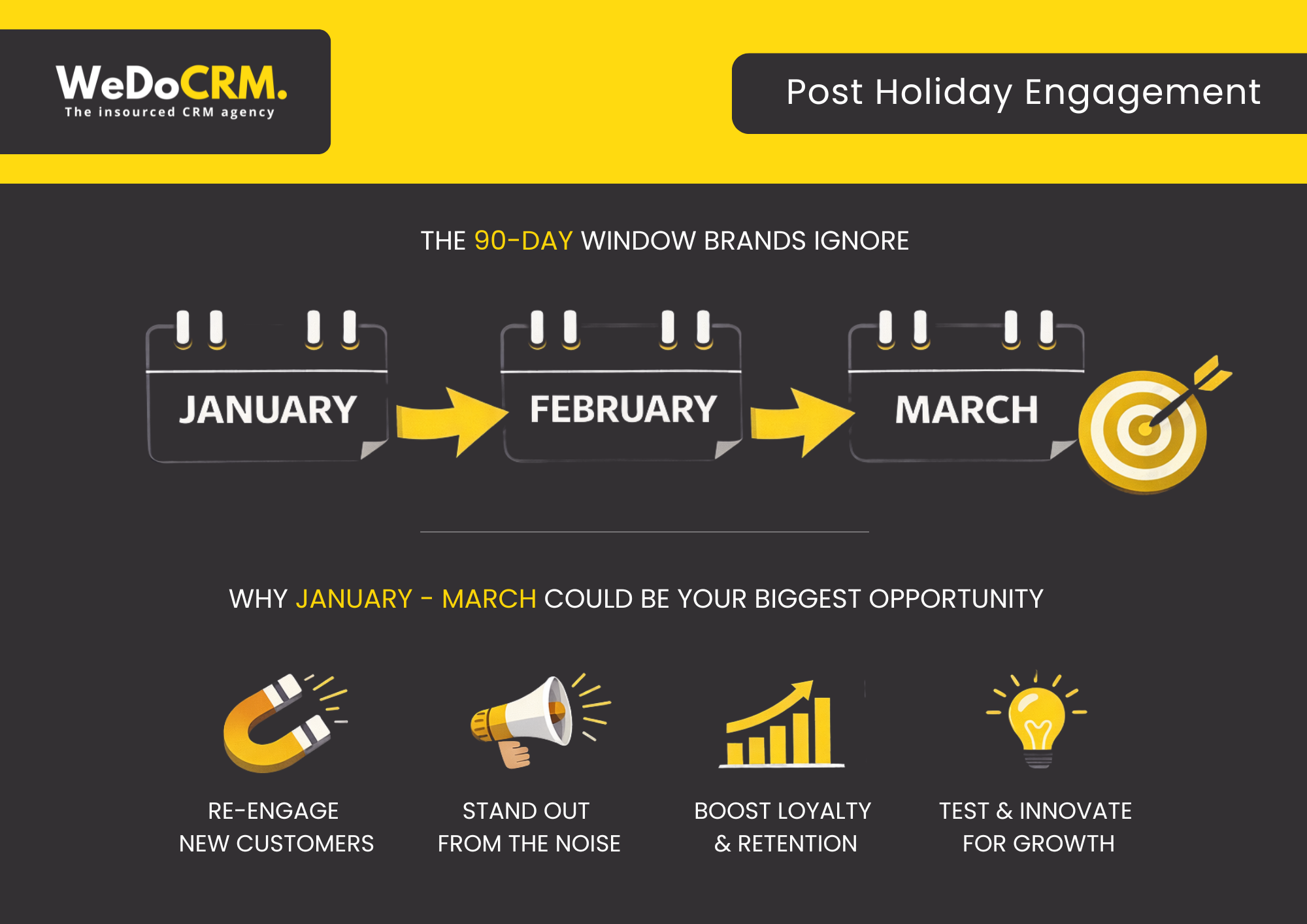
Bottom line: Don’t let post-holiday momentum slip away – the first quarter is your secret growth window.
Turning Holiday Shopping Behaviour Into 2026 CRM Strategy
Let’s start with Christmas as an example. Christmas is one of the richest behavioural data moments your CRM platform will ever see for personalised marketing.
It shows you:
- Who responds to urgency vs value
- Who buys because they love your brand – and who buys because it’s 40% off
- Which channels actually drive meaningful engagement
- Who sticks around once the discounts disappear
If you’re only measuring December conversions, you’re missing the real gift.
Every year, we see brands make the same rookie mistake: treating holiday campaigns as a finish line instead of the starting point and launchpad for future strategy. The real value isn’t just in the sales (I mean, sales are also great), but it’s what you actually learn from your customers. Every click, every abandoned cart, and every last-minute gift tells a story about what your shoppers like, want, and how they make decisions.
Used the right way, it can guide all your marketing long after the last Christmas cookie is eaten, and the holidays are over. For example, we’ve compiled a table that outlines what to look for and capture within your CRM platform.
Holiday Behavioural Signals to Capture in The CRM / ESP Platform
What it tells you and how to use it:
| Behaviour Signal | What It Tells You | How to Use It |
| Entry channel (email, paid, organic) | Channel preference | Personalise future channel mix |
| Time-to-purchase | Decision speed | Adjust urgency messaging |
| Discount usage | Price sensitivity | Reduce over-discounting |
| Products viewed vs purchased | Intent gaps | Improve cross-sell & content |
| Abandoned baskets | Friction points | Trigger recovery journeys |
| Engagement depth | Interest level | Segment high-intent users |
CRM tip: Store these as custom events or attributes – not just reports.
Smart Post-Holiday Campaign Examples
At WeDoCRM, we don’t just run holiday campaigns — we turn the insights from these peak periods into long-term growth strategies. Here are three examples of how we’ve done this for our clients:
1. WeDoCRM Replenishment Campaigns for Consumables
The Challenge:
A health & wellness brand came to us after a busy holiday season. They’d acquired hundreds of first-time buyers of vitamins and supplements, but post-holiday engagement dropped off sharply.
Our Approach:
We analysed purchase quantities and typical consumption rates to predict when customers would need a reorder. Then we created a staggered, automated email journey:
| Timing | Content | Goal |
| Week 1 | “Getting Started” guide: tips for taking supplements correctly | Education & engagement |
| Week 3 | Reminder: “Running low?” with easy reorder link | Encourage first repeat purchase |
| Week 5 | “Never run out again” subscription offer (10% off first month) | Convert to recurring revenue |
2. WeDoCRM “Complete the Collection” Campaigns
The Challenge:
A tech accessories client saw one-off purchases of gaming mice during Black Friday. Customers weren’t buying complementary items, which limited revenue potential.
Our Approach:
We mapped product relationships to identify natural pairings and staged a contextual, behaviour-driven campaign:
| Timing | Content | Goal |
| Week 2 | “Getting the most from your new mouse” + recommended mousepad | Engagement + cross-sell |
| Week 4 | “Pro gamers also use…” + headset recommendation | Continue education + cross-sell |
| Week 6 | “Complete your setup” + bundle offer | Maximise repeat purchase & basket size |
3. Holiday-Specific Segmentation & Reactivation
The Challenge:
A D2C fashion brand acquired hundreds of new customers during the holiday rush, many of whom hadn’t shopped before. Standard “thank you” emails weren’t enough to turn them into repeat buyers. It needs to be more for personalised marketing.
Our Approach:
We segmented customers based on:
- Purchase type (full-price vs discounted)
- Channel (email, social, paid)
- Product category purchased
Then we launched personalised post-holiday journeys that included:
- Re-engagement emails highlighting new arrivals related to previous purchases
- Follow-ups for discounted buyers emphasising brand values rather than discounts
- Cross-sell campaigns suggesting complementary items to first-time buyers
Steal these strategies – we won’t tell! Reading about all this is one thing. Actually setting up the event tracking, building the workflows, fixing the integrations, and testing everything? That’s the part that makes people want to scream into the void. If you’d rather not do that, book a call. We’ll handle the technical nightmare, and you can take credit for the results. We would love to hear from you!
How WeDoCRM Can Help You
Your CRM already has everything you need to make smarter decisions in 2026 – it just needs the right strategy behind it for personalised marketing.
You don’t need to have all the answers – that’s what we’re here for!
If you’d like a fresh pair of eyes on your CRM and how you’re using your customer data, book a discovery call with us.
Want more insights? Check out:
- Multichannel vs Omnichannel Marketing – How CRM can boost results
- AI and CRM: Enhancing Personalisation – Deep dive into AI magic
- Why Your Loyalty Strategy Needs an Upgrade – Tips to measure customer loyalty
- Why WhatsApp Marketing is Powerful – Check out other ways to do marketing